Midterm 2026: How Chamber Control Shapes Congress's Final Two Years
With polls open, the outcome of Tuesday's election will determine whether Congress investigates the administration, advances Jeffries' agenda, or confirms key nominees.
By Ayanda Boateng ·
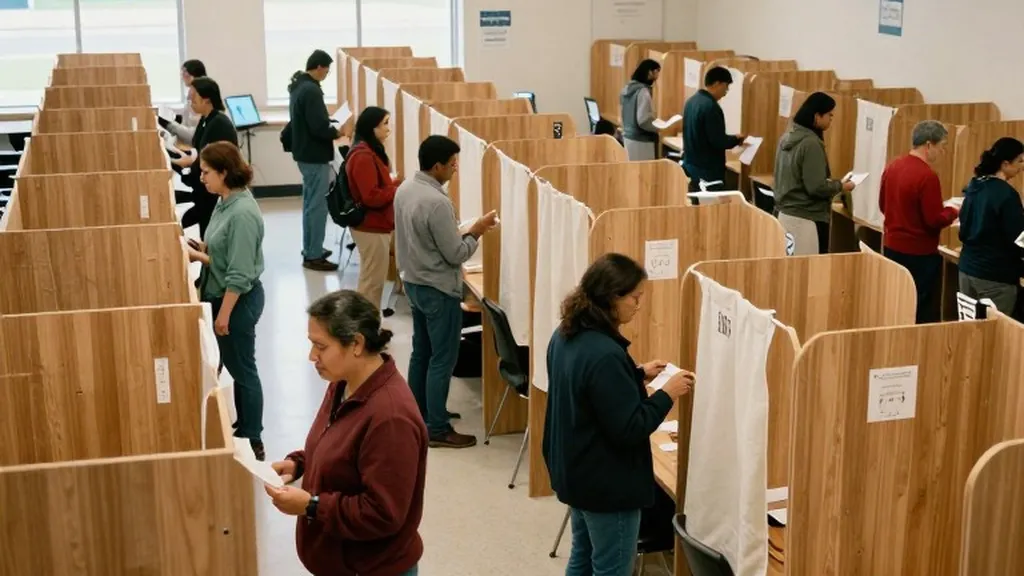
Voters across the country are casting ballots on Tuesday, November 3, 2026, to decide who controls the U.S. House and Senate for the final two years of President Donald Trump's second term. All 435 House seats and 35 Senate seats are up for grabs, with the contest described as a referendum on the current administration's handling of high prices and the war with Iran. Democrats need a net gain of three House districts and four Senate seats to achieve majorities, while Republicans can afford to lose only two seats in each chamber to maintain their current control. The stakes are high because a shift in power would immediately alter the legislative and oversight landscape in Washington.
In the House, the outcome will dictate the pace and scope of investigations into the executive branch. If Democrats secure a majority, House Democratic Leader Hakeem Jeffries, who would become the first Black speaker, has outlined a 100-day agenda focused on the cost of living and oversight. This agenda implies a rigorous review of government spending and policy implementation. Conversely, if Republicans retain their slim majority, they are positioned to continue their current legislative priorities with less scrutiny from the opposition. The Associated Press notes that one or two seats could tip the balance in either chamber, making the battleground districts critical to the final count.
Senate control is equally pivotal for the confirmation of nominees. With 35 seats at stake, including two special elections to fill the seats of Marco Rubio and JD Vance, the balance of power will determine how quickly the president can fill vacancies and advance his judicial and cabinet choices. Republicans currently hold 53 seats, while Democrats hold 45, plus two independents who caucus with Democrats. A loss of more than two Senate seats would hand the chamber to Democrats, potentially leading to delays or rejections of key appointments. The Associated Press highlights that Democrats are cautiously optimistic, while Republicans are bracing for the possibility of losing the House while fighting to hold the Senate.
The 2026 election also carries implications for the 2028 presidential cycle. A strong performance by Democrats would boost the profiles of potential candidates such as Gavin Newsom, JB Pritzker, and Pete Buttigieg. A Democratic victory could complicate the path for Vice President JD Vance, who is seen as a leading contender for the Republican nomination. On the other hand, a Republican hold would solidify their base and provide a platform for their preferred candidates. The race in Kansas, a traditionally Republican state, has become central to the fight for Senate control, with the state's competitive nature reflecting broader national trends.
Campaign spending has reached record levels, with the 2026 elections likely to be the most expensive in history. Republican committees outraised and outspent Democratic committees, aided by Trump-affiliated groups and Elon Musk. However, at the candidate level, Democrats outraised their opponents. An analysis of AdImpact data found that 88.1% of Republican general election TV ad spending went to states and districts Trump won in 2024, including more than $850 million in areas where he won by 10 points or more. This spending strategy reflects the parties' focus on defending key territories rather than expanding their bases in traditionally opposed states.
The mood among voters is characterized by economic anxiety and dissatisfaction with the status quo. The Associated Press notes that 35% of U.S. Adults approve of Trump's job performance, while only 25% approve of his handling of the economy. About seven in 10 Americans say the country is heading in the wrong direction, with most blaming the president for high prices. Voter Mark Barker of Palm Beach Gardens, Florida, expressed support for the president, stating that he is doing an awesome job. In contrast, James Moore, a librarian in Raleigh, North Carolina, cited rising taxes and healthcare costs as reasons for his vote. These divergent views highlight the deep divisions that will be resolved by the final tally.
Election administration has been a point of contention, with the Trump administration filing lawsuits in Alaska and California over voting procedures. A federal judge temporarily barred the administration from implementing a plan to prevent noncitizen voting, while another judge ordered the administration to stop demanding that California officials segregate ballots cast by people on suspected noncitizen lists. Democrats fear interference and intimidation as the Justice Department threatens to prosecute local election officials. These legal battles have added a layer of complexity to the election, with critics arguing that the measures risk disenfranchising eligible voters and infringing on states' authority over elections.
More than 57 million people had already voted as of Monday, surpassing the early vote of four years ago in many closely watched states. This high early turnout suggests that the final results may be determined by the last-minute voters who head to the polls on Tuesday. The U.S. Postal Service added hours, staff, and special lines to ensure that mail ballots are counted on time, reflecting the importance of these votes in states that rely heavily on mail-in voting. The Associated Press describes the election as a critical moment for both parties, with the outcome potentially reshaping the political landscape for the next two years.
As polls close across the country, the focus turns to the 46 battleground districts and 13 Senate races that will determine the balance of power. The Associated Press highlights that new congressional maps in six states, including California, Florida, and Texas, may alter the traditional voting patterns. The Associated Press notes that Democrats need a net gain of two governorships to achieve a nationwide majority, a position Republicans have held since 2010. The outcome of these races will influence not only the immediate legislative agenda but also the long-term strategy of both parties in the years to come.