Netanyahu Orders Hebron Homes Flattened Ahead of Vote
Bulldozers began clearing a neighborhood in Hebron on Friday following a checkpoint attack that killed two Israeli soldiers, with national elections scheduled for October 27.
By Chioma Kuznetsov ·
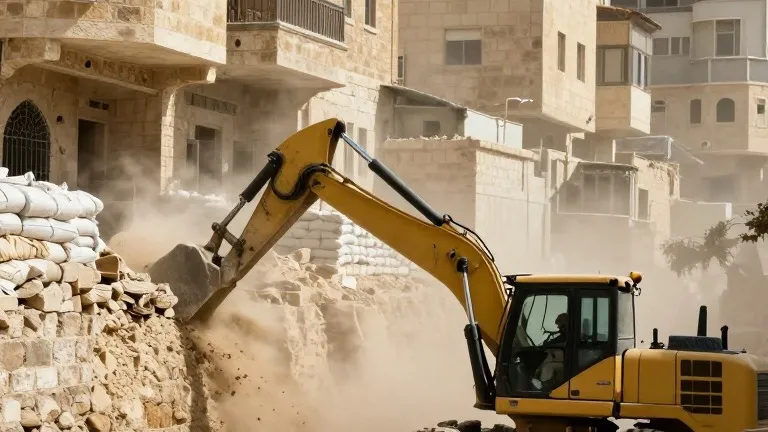
Bulldozers began flattening homes in a Hebron neighborhood on Friday afternoon.
The destruction followed an attack at an Israeli checkpoint that killed two soldiers and wounded three others. Prime Minister Benjamin Netanyahu promised a military operation in the West Bank on a scale not seen since the Six Day War. He spoke from the site of the shooting and said, "We will act to demolish this place, to change it completely."
The Israeli military stated that soldiers were behind concrete barriers when two gunmen opened fire. The firefight lasted about 20 minutes until troops killed the attackers. The operation mirrors last year's assault on two Palestinian refugee camps in the northern West Bank, which displaced tens of thousands of people. Human Rights Watch called those expulsions war crimes, a charge Israel rejects.
B'Tselem, an Israeli human rights group, urged foreign governments to intervene. The group warned against another wave of ethnic cleansing and war crimes. The United Nations Human Rights Office described the current situation as a new level of dehumanization of Palestinians. Israel has imposed widespread closures in Hebron, the most populous city in the occupied West Bank, making movement difficult. The territory currently has about 925 checkpoints, roadblocks, and earth mounds.
Analysts link the scale of the response to national elections scheduled for October 27. Polls show Netanyahu and his main rival, Gadi Eisenkot, running neck and neck. Neither candidate currently has enough support to form a government. Danny Citrinowicz, a senior researcher at the Institute for National Security Studies in Tel Aviv, said Netanyahu's ticket before the election is that he is Mr. Security. He argued that Netanyahu will take harsh measures to show the Israeli public he is defending them.
Citrinowicz described the eviction of families from the attackers' neighborhood as collective punishment. He noted there was no evidence linking those families to the gunmen. He said the way to prevent more attacks is not through collective punishment but by giving hope. He urged authorities to arrest those who want to carry out attacks while helping those who want to live peacefully with a working economy.