Morocco Sees UN Withdrawal as Victory in Western Sahara Dispute
The end of the Minurso mission follows a Security Council deadlock, with Morocco urging a shift toward its autonomy plan while Polisario warns of rising risks.
By Chioma Kuznetsov ·
Morocco has declared a diplomatic victory following the expiration of the United Nations mission in Western Sahara on October 31, a move that reshapes the dynamic of the region's longest-running territorial conflict. The UN Mission for the Referendum in Western Sahara, or Minurso, entered a liquidation period on November 1 after the Security Council failed to reach a consensus on renewing its mandate. This outcome leaves a vacuum in the monitoring of the fragile ceasefire between Rabat and the Polisario Front, which has contested the territory for more than five decades.
The diplomatic standoff at the UN stemmed from two competing drafts. The United States proposed a one-year extension that would have removed the word "referendum" from the mission's name and anchored future talks in Morocco's autonomy proposal. While this draft secured the backing of 11 of the 15 council members, including France and the United Kingdom, Russia cast a veto, arguing the terms favored Morocco. A subsequent Russian draft to extend the mission without altering its original terms also failed, garnering only two votes in its favor.
Minurso had been stationed in the region since 1991 to monitor the ceasefire and organize a referendum on the territory's status. That vote, originally planned for 1992, never occurred due to disagreements over voter eligibility. The mission employed 155 military personnel and was budgeted at $62 million for the financial year beginning in June. Its withdrawal means the UN will no longer actively oversee the sand wall that separates the forces of Morocco and Polisario.
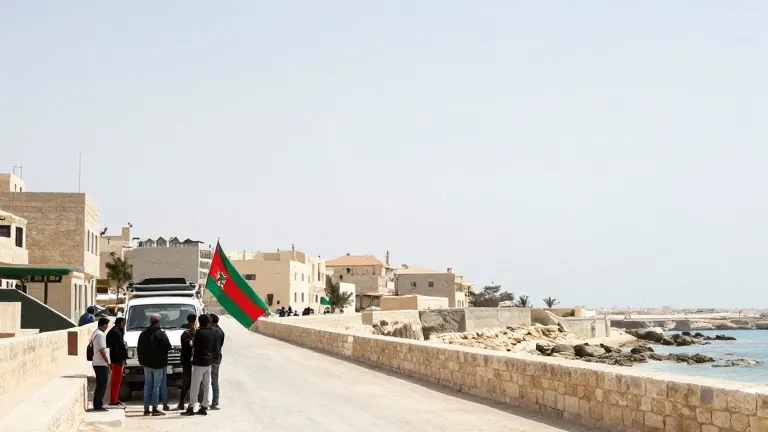
Reactions to the decision have been sharply divided. In Laayoune, the territory's largest city, residents waved flags and displayed portraits of King Mohammed VI in celebration. House of Representatives Speaker Ahmed Touizi addressed a special parliamentary session on Monday, describing the outcome as a triumph for Morocco's diplomatic efforts. He stated that the country should now focus on implementing its autonomy plan and advancing development projects in the region.
Conversely, the Polisario Front condemned the US proposal and expressed gratitude to Russia for its veto. Representative Sidi Omar described the US plan as a move that would "torpedo the foundations of the UN peace process." The group, supported by Algeria, has long insisted on a referendum that includes independence as an option. UN Secretary-General Antonio Guterres warned that the Sahrawi people's right to self-determination must be respected and cited the risk of renewed hostilities in the absence of the mission.
Morocco argues that the issue should no longer be a standing item for the Security Council, while Polisario has yet to announce its next strategic steps. Analysts note that the decision does not alter Western Sahara's legal status, which remains on the UN list of non-self-governing territories, even as the African Union recognizes the Sahrawi Arab Democratic Republic. The shift may allow Rabat to leverage regional support, with at least 10 African nations having opened diplomatic missions in the territory to back Morocco's position.
Security experts warn that the departure of Minurso could create gaps in conflict monitoring. Oxfam cautioned that the loss of the mission's de-escalation role could undermine stability for civilians. Issam Laaroussi, a Moroccan international relations expert, noted that while the conflict predates the mission, its absence could aggravate an already fragile security environment. Foreign Minister Nasser Bourita maintained that the ceasefire remains intact, though he acknowledged the need to respect Morocco's security and sovereignty.
The dispute also drives military spending in the region. The Stockholm International Peace Research Institute reported that Algeria and Morocco both increased their defense budgets last year. Algeria's estimated expenditure of $25.4 billion was more than four times Morocco's $6.3 billion, with the Western Sahara conflict cited as a primary driver for these fiscal commitments.