Swift Telescope Falls: NASA Ends 22-Year Mission
Solar activity lowered the orbit of the 1.5-ton observatory, leading to a reentry near Indonesia after a failed private rescue attempt.
By Ayanda Boateng ·
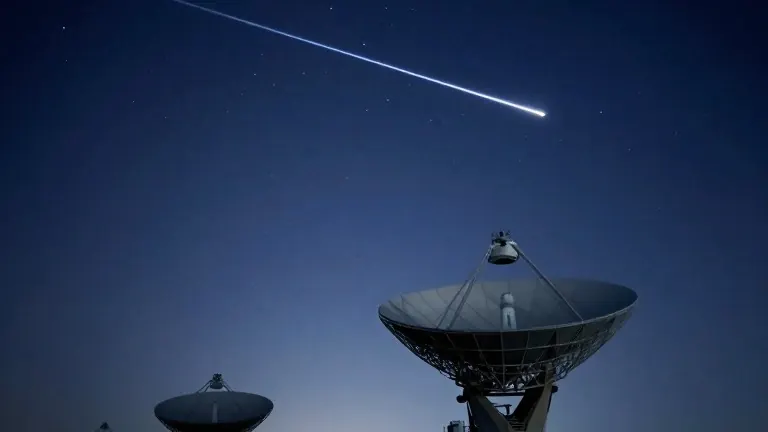
NASA’s Swift Observatory reentered Earth's atmosphere on Wednesday, ending a 22-year run that tracked the universe's most violent cosmic events. The spacecraft descended near Indonesia, concluding a mission that outlasted its original two-year design by more than a decade. This marks the end of an era for a telescope that served as a primary detector for gamma-ray bursts.
The descent was triggered by intense solar activity over the past few years, which increased atmospheric drag and lowered the satellite's orbit. The U.S. Space Force tracked the sinking trajectory and confirmed the reentry. Before this final fall, NASA attempted a last-minute intervention. The agency hired Katalyst Space to launch a three-armed robotic craft designed to boost Swift's orbit. However, the rescue vehicle encountered issues after its launch in July and crashed in September, leaving the observatory to its fate.
Swift launched in 2004 with the goal of studying exploding stars and gamma-ray bursts. It observed thousands of these events over 22 years. Its role was critical for other telescopes, as it acted as a first responder to alert them to look deeper at specific locations. The spacecraft weighed 1.5 tons. While not all of it burned up in the atmosphere, NASA expects some denser components survived the reentry.
The loss of Swift prompts a look at the future of other aging assets. NASA is currently evaluating options for the Hubble Space Telescope, which launched in 1990. Similar solar storms are eroding Hubble's orbit. Recent analyses suggest Hubble could fall to Earth by the mid-2030s. The space agency is soliciting input from private companies on potential rescue strategies. These could include orbit boosts, system upgrades, or a controlled reentry.
Any intervention for Hubble must occur by 2032. NASA has more time to plan this effort than it did for Swift. Nicky Fox, the agency's science mission chief, noted that the timeline allows for a more thorough exploration of options. NASA Administrator Jared Isaacman emphasized the value of the telescope in a statement. "Hubble still has important science ahead of it," Isaacman said, "and we should be looking at every reasonable opportunity to keep it delivering for as long as possible."
The Swift mission operated for 11 times longer than its planned duration. The spacecraft collected data on thousands of gamma-ray bursts and supernovae. Its failure to be saved by the Katalyst Space vehicle highlights the challenges of rescuing aging satellites in low Earth orbit. The Swift reentry serves as a practical test case for the methods NASA may need to apply to Hubble in the coming years.