Cosmic Background Analysis: Massive Black Holes Likely Not Dark Matter
Researchers at the Mainz Institute for Theoretical Physics and New York University Abu Dhabi used early universe light to limit the contribution of supermassive objects to the cosmos's invisible mass.
By Ayanda Boateng ·
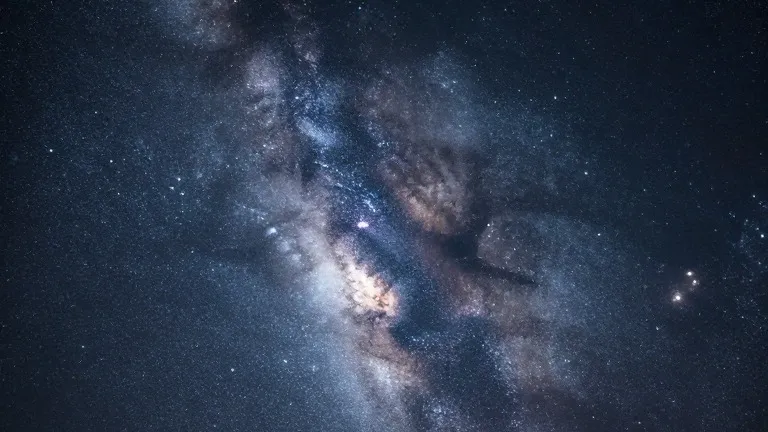
Black holes with masses exceeding 100 billion times that of the sun likely do not constitute a major fraction of dark matter, according to a new analysis of the cosmic microwave background. The study, led by theoretical physicists at the Mainz Institute for Theoretical Physics in Germany and New York University Abu Dhabi, places strict limits on the prevalence of these hypothetical "stupendously large" objects. The findings suggest that the universe's invisible mass is not concentrated in a few gigantic bodies, but rather distributed in a smoother fashion.
Dark matter was initially proposed to explain why galaxies maintain their structure despite high rotational speeds. It is estimated to comprise approximately five-sixths of all matter in the universe. While the substance remains elusive, black holes have been considered a plausible candidate due to their mass and low visibility. Previous surveys have detected black holes up to roughly 36 billion solar masses, but no object has yet been confirmed to reach the scale of an entire galaxy.
Co-author Christopher Gerlach explained that if dark matter were clumped in such massive objects, it would create a "grainy" structure on large scales. By examining the cosmic microwave background, the light released 380,000 years after the Big Bang when the universe cooled enough for atoms to form, the team looked for this graininess. The background acts as a snapshot of the infant universe covering the entire sky.
The analysis revealed that the temperature of this background varies by only about one part in 100,000 across different regions. This smoothness indicates that matter was distributed relatively evenly at that early stage. If stupendously large black holes had been abundant, the background would have shown distinct fluctuations. "So these black holes can't be a significant part of the dark matter," stated co-author Nicholas Leister, a theoretical physicist at the Mainz Institute.
The results do not rule out the existence of such massive black holes entirely, only their role as a primary component of dark matter. The authors noted that smaller black holes, roughly the size of asteroids, remain a possible candidate and are currently under investigation. The team is now working to determine if these smaller objects can also be excluded as a major constituent.
The study is scheduled for publication in the journal Physical Review Letters on Oct. 26. This data point narrows the range of viable explanations for the universe's missing mass, shifting focus away from extreme upper limits in black hole mass.