
Crows Process Visual Decisions at Twice the Speed of Primates
New research indicates that carrion crows use the same mathematical logic as monkeys for decision-making, but with a significantly faster processing time.
By Chioma Kuznetsov ·
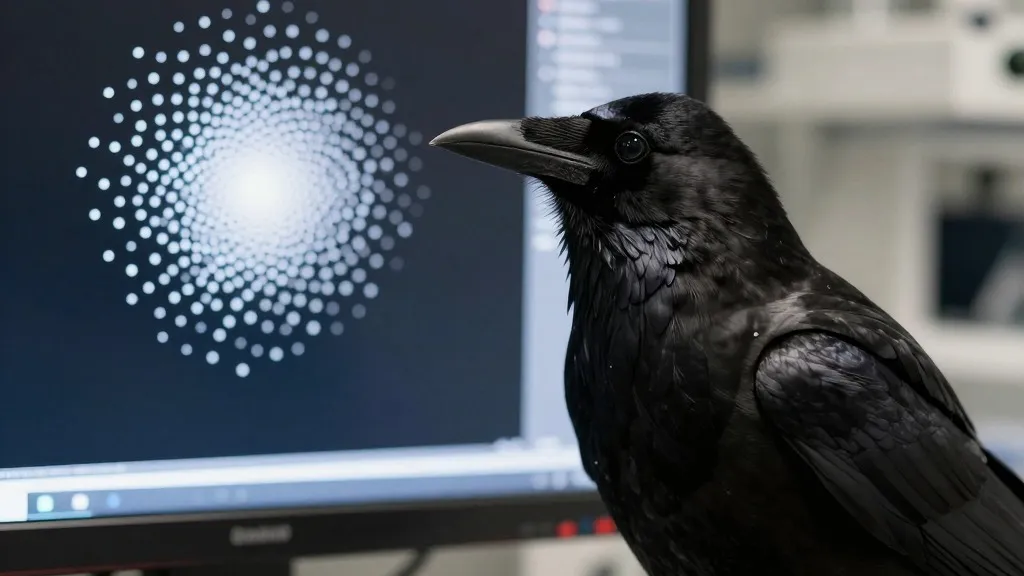
For ordinary observers, the study confirms that birds are not merely following simple instinct when they navigate complex environments. The findings suggest that crows process visual information with a speed that outpaces their primate counterparts by a factor of two. This discovery reshapes the understanding of how different brain architectures handle the basic task of choosing between options in a noisy world.
The core of the investigation relies on a standard test known as the random-dot-motion task. In this experiment, a cloud of flickering specks drifts weakly in a specific direction. The subject must determine if movement exists and identify its path. In primates, previous research has established that neurons in the neocortex collect visual evidence over time. Their firing rates climb until they cross a threshold, at which point the animal commits to a choice. However, birds lack a neocortex, leaving the mechanism for similar decisions unclear.
Andreas Nieder, a neurobiologist at the University of Tübingen, described the structural difference as the central puzzle. He stated, "This was the big question." He further explained, "How [would] a differently organized avian brain encode decisions?" To address this, Nieder and colleague Philipp Schmidbauer subjected two hand-raised carrion crows to the same rigorous testing protocol used for monkeys.
The experimental setup required the birds to sit in front of a touch-sensitive monitor displaying white dots on a black background. A portion of these dots would drift together to the left, right, up, or down. The crows indicated their choice by pecking one of the targets located beside the display. A correct answer rewarded the bird with a mealworm. Nieder noted that the team kept the setup identical to the monkey version to ensure a fair comparison.
Nieder emphasized the precision of the methodology. He said, "We intentionally wanted to have exactly the same random-dot motion task." The only operational difference was the response method. While monkeys indicated their decisions through eye movements, the crows had to peck to confirm their choice. This minor adjustment allowed the researchers to isolate the cognitive processing from the motor output.
The researchers varied the difficulty of the task by altering the proportion of dots that moved in a coherent direction. At the easy end of the spectrum, 81 percent of the dots moved together, making the direction trivially easy to read. At the hardest end, only 3 percent moved coherently, a level barely distinguishable from random noise. The team also included a condition where 0 percent of the dots moved, ensuring there was no correct answer.
The results show that the crows solved the task using the same mathematical logic as primates. Despite their brains being organized very differently, the birds arrived at decisions through a comparable process. The critical difference lies in speed. The crows completed the decision-making process twice as fast as the monkeys. This finding indicates that a brain without a neocortex can achieve efficient decision-making through alternative neural pathways.
The study highlights the efficiency of avian cognition. It suggests that the lack of a specific brain structure does not hinder the ability to process complex visual information. Instead, it may allow for a more rapid response to environmental cues. This has implications for understanding how different species adapt to their surroundings and make choices under uncertainty.