Voyager Lander Completes Final JPL Environmental Tests
The Griffin-1 spacecraft passed vibration and thermal trials, clearing the way for a late 2026 launch to the lunar south pole.
By Ayanda Boateng ·
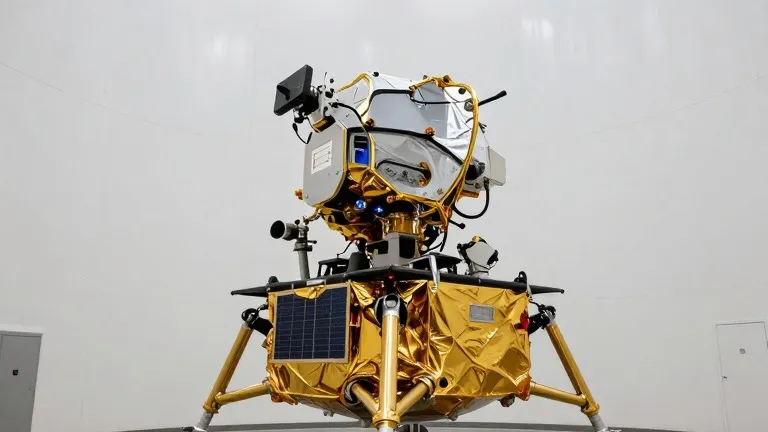
Voyager Technologies confirmed on Oct. 23 that its Griffin-1 lunar lander has passed the final set of environmental tests at NASA's Jet Propulsion Laboratory in Southern California. The completion of these trials marks the last major ground-based hurdle before the spacecraft's scheduled launch later this year.
Engineers subjected the lander to conditions that mimic the stress of a journey to the moon. The test campaign included exposure to extreme temperatures, intense vibration, and high acoustic noise levels. JPL officials stated that the spacecraft successfully endured all phases of the environmental test sequence.
An image from Aug. 31 shows the vehicle inside JPL's space simulator, a chamber 25 feet, or 7.6 meters, wide. Charles Whetsel, manager of the Exploration Systems Development Office at JPL, noted that the laboratory's Environmental Test Laboratory has supported robotic explorers since the Ranger program. He said in a statement, "We're proud to provide our expertise and facilities to support this new phase of commercial lunar exploration."
Griffin-1 will operate under NASA's Commercial Lunar Payload Services initiative. The lander is designed to deliver more than 1,100 pounds, or 455 kilograms, of cargo to a site near the lunar south pole. The payload consists of scientific experiments and new technologies intended for surface testing.
Among the hardware aboard the lander is the FLIP rover from Astrolab. This vehicle is equipped with a supercomputer and will explore the terrain once the lander touches down. The mission is part of a multi-year effort to establish infrastructure for a future crewed lunar base, which NASA plans to build near the south pole within the next five years.