Tim McCollum Captures Halley's Comet Debris Over Georgia
An astrophotographer recorded three meteors from the Orionid shower near Toccoa, Georgia, on October 21, merging long-exposure frames to show the debris against the Milky Way.
By Aiko Soto ·
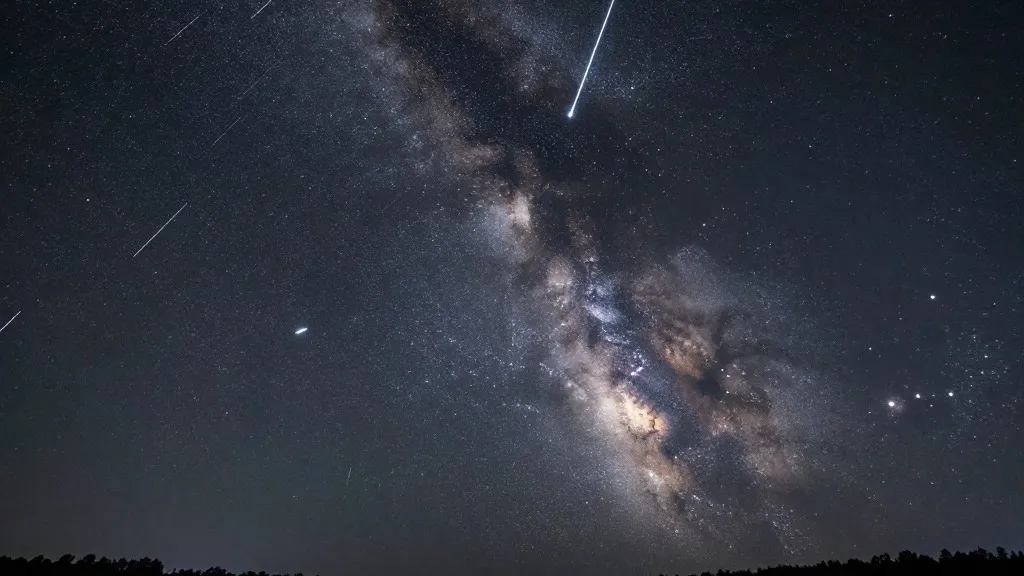
The Orionid meteor shower is currently active, producing visible meteors across North America as Earth moves through a trail of space debris. On October 21, astrophotographer Tim McCollum documented three of these meteors in the sky above Toccoa, Georgia.
McCollum photographed the events between 3 a.m. and 4 a.m. local time. The meteors visible in his composite image are fragments shed by Comet 1P/Halley. Although the comet itself is located more than 3 billion miles from Earth, the particles it released remain in orbit and burn up in the atmosphere as they enter it.
In the image, the meteors appear to streak away from a specific point in the constellation Orion. This radiant point sits near the red giant star Betelgeuse. The visual effect is a result of perspective, as the parallel paths of the meteors converge from the observer's viewpoint.
Capturing these fleeting events requires precise timing and specialized equipment. McCollum used a Canon EOS Ra camera paired with an RF 28-70 f2.0 lens. He took multiple 30-second exposures while a star tracker kept the camera aligned with the radiant.
After taking the individual frames, McCollum combined them into a single composite image using PixInsight software. The final photograph includes several deep sky objects in addition to the meteors. The stars of Orion's Belt are visible on the right side of the frame, close to the glow of the Orion Nebula.
The Orion Nebula is one of the nearest major star-forming regions to Earth. The image also captures the Rosette Nebula, known as Caldwell 49. This nebula is situated within the dense starfield and dust lanes of the Milky Way's galactic plane, which runs diagonally across the composite. Numerous star clusters are also distinguishable in the background.
The annual Orionid shower will continue through November 7. Observers in dark sky locations can still view the display with the naked eye. The meteor rate is expected to peak around the current date, offering the highest probability of sightings for the next few nights.
Earth is also passing through debris streams from Comet 2P/Encke during this period. These streams produce the Taurid meteor shower. The interaction with Taurid debris can result in occasional bright fireballs, often referred to as Halloween Fireballs, which may appear alongside the Orionids.
McCollum's photograph demonstrates the capability of ground-based astrophotography to record both transient atmospheric events and static celestial objects. The image was taken earlier this week as the shower approached its maximum activity levels.