Eckerd scholars debate the blurring lines between faith and politics
Two academics visited the campus to discuss how religious concepts influence national security and the visibility of Muslims in American elections.
By Aiko Soto ·
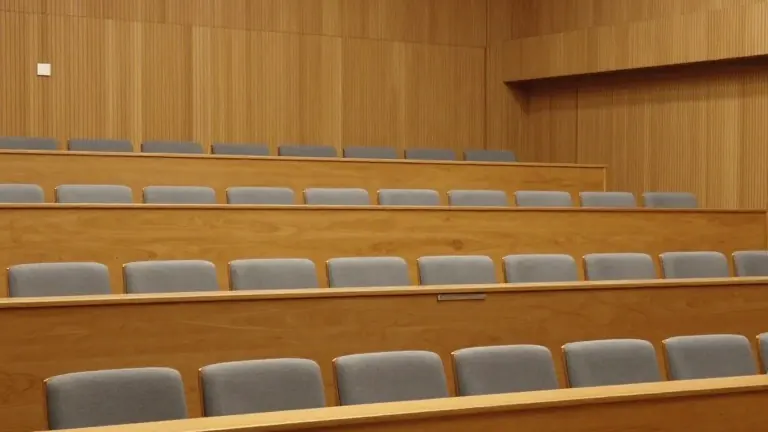
Elizabeth Shakman Hurd of Northwestern University and Tazeen Ali of Washington University in St. Louis visited Eckerd College to discuss the intersection of religion, politics, and public life in the United States. The event was hosted by McCrary, who invited the scholars to the campus to explore how these two spheres of life interact. The discussion took place in front of a student audience, with questions guided by Chaplain and Director of the Center for Spiritual Life Robert Galloway.
Hurd, a professor of political science and religious studies, argued that the separation between the religious and the political is often less distinct than people assume. She suggested that this overlap matters for how Americans understand their civic duties. Her research focuses on political theory and international relations, with a specific interest in how borders function as both political and religious objects.
She cited her book, “Heaven Has a Wall: Religion, Borders, and the Global United States,” to illustrate her points. Hurd posited that Americans often treat national security as a sacred concept, placing it above the reach of the law. She referenced the work of religion scholar Kathryn Lofton to explain that religion is not just an institution one joins, but a force that can ensnare individuals. “Like both politics and religion, national security draws you into something bigger,” Hurd said. “You’re compelled to participate.”
Tazeen Ali, an assistant professor of religion and politics, presented her current research on how television constructs perceptions of Islam. Her work examines Islam and gender, and she is currently writing a book tentatively titled “Muslims on Screen: Racism and Sexuality in Anglo-American Islam.” Ali used recent events in American politics to frame her concepts, pointing to the public visibility of Muslim candidates.
She referenced Michigan Democratic Senate candidate Abdul El-Sayed, who responded to a question about disavowing the Muslim Brotherhood by stating, “I’m not running to be a Muslim senator. I’m running for U.S. Senate and happen to be Muslim.” Ali noted that this statement reveals a shifting dynamic for Muslims in American public life. She encouraged the audience to consider how television developments might change how people view the growing presence of Muslims in electoral politics.
Students who attended the panel reported taking away new ways to think about the category of religion itself. Lexi Davis, a junior religious studies and humanities major from Mountain View, California, said the event prompted her to dismantle her predetermined definitions of religion. She began to look for hidden ties between religion and culture in everyday American life. “If we can discern these tiny bits of religion in everyday American culture, what will that tell us about America?” Davis asked.
Jasmine Fernald, a junior anthropology major from New Carlisle, Indiana, also reflected on the discussion. Fernald noted that the event highlighted how intertwined religion and government truly are, despite common assumptions about their separation. “We like to say that religion and government are separate, but they are so intertwined,” Fernald said.
McCrary stated that the goal of the event was to help students develop new questions and lenses for viewing religious ideas in politics and life. He noted that these ideas appear across the political spectrum, from Christian nationalists on the right to a seminarian hoping to flip a Texas Senate seat blue. “If you don’t really know what you’re looking for, you’ll miss it. And I would like people to start looking for it and stop missing it,” McCrary said.
The scholars concluded their remarks by inviting the audience to consider how these overlapping domains shape daily decisions. The panel ended with the students returning to their regular classes, carrying the questions raised during the discussion into their academic work.