Eagle's Nest Fire: Bavaria Weighs Rebuilding Nazi Ruins
Officials in Bavaria and historians clash over whether to reconstruct the charred mountain retreat or leave it to decay.
By Aiko Soto ·
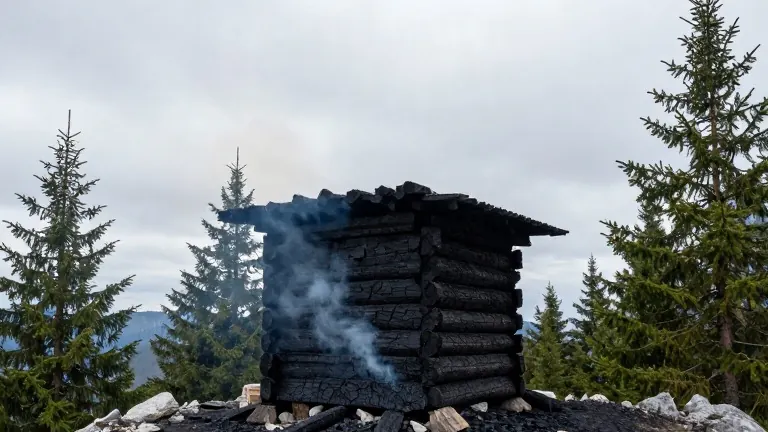
The Kehlsteinhaus, a mountain retreat built by the Nazis in 1938, was gutted by fire on the evening of October 23. The blaze destroyed the structure that once served as a restaurant for tourists visiting the Bavarian Alps. Police suspect arson and have detained a 33-year-old man in a psychiatric hospital. The nearby Obersalzberg Documentation Centre, a museum dedicated to the Nazi era, remained intact.
The building sat at 1,834 meters above sea level near Berchtesgaden. For decades, visitors rode a brass and mirror-paneled lift to the site. Tens of thousands of tourists visited each season, providing a steady stream of revenue for the local economy. The structure had been classified as a historical monument since World War II. A photo exhibition detailing the building's history had been displayed inside for roughly 15 years.
Bavarian state officials have moved quickly to defend the site. Interior Minister Joachim Herrmann argued against leaving a ruin on the mountain ridge. He stated, "We can hardly leave a ruin standing there." Arts Minister Markus Blume added that any reconstruction project should not cost taxpayers money. Both leaders said they would consult with historians to determine the best path forward.
Historians in the United Kingdom have proposed a different approach. Professor Sir Richard J. Evans of the University of Cambridge suggested clearing the rubble entirely. He described the Kehlsteinhaus as a vanity project that was later romanticized. Evans pointed to the Berlin bunker where Hitler died, noting that it was filled with concrete and covered by a children's playground. He argued the mountain should return to its natural state.
Sven Keller, who leads the Obersalzberg Documentation Centre, warned that abandoning the ruins could create a pilgrimage site for neo-Nazis. He noted that clearing the area might allow them to hike up undisturbed. Keller also expressed doubt that a one-to-one reconstruction was feasible. He reminded officials that Hitler's Berghof residence was demolished in the 1950s but did not vanish from public memory.
Isabel Heinemann, a history professor at the Ludwig-Maximilians-Universität in Munich, argued that a full rebuild would restore highly ideological architecture. She favored a modern design that documents the fire damage and keeps the different layers of time visible. She stated that Germany has an everlasting responsibility to deal with its Nazi past.
The debate occurs as the far-right Alternative for Germany party gains strength. In Saxony, AfD and CDU councillors recently moved to ban commemorative plaques known as stumbling stones. In Austria, a police station opened in the house where Hitler was born in Braunau am Inn. The government said the move would deter pilgrims, though critics argued it did not actively confront the past. The fate of the Eagle's Nest now forces a decision on how to manage these physical remnants.
The decision will rest with Bavarian authorities and their historical advisors. The charred ruins stand on the ridge as the state weighs its options. The site remains a focal point for national discussion on memory and architecture.