Coral Gables Turns Out at 14 Polls, with St. Augustine Church Drawing Key Midterm Voters
Local issues and healthcare priorities drove turnout at a polling site that has operated since 2011.
By Chioma Kuznetsov ·
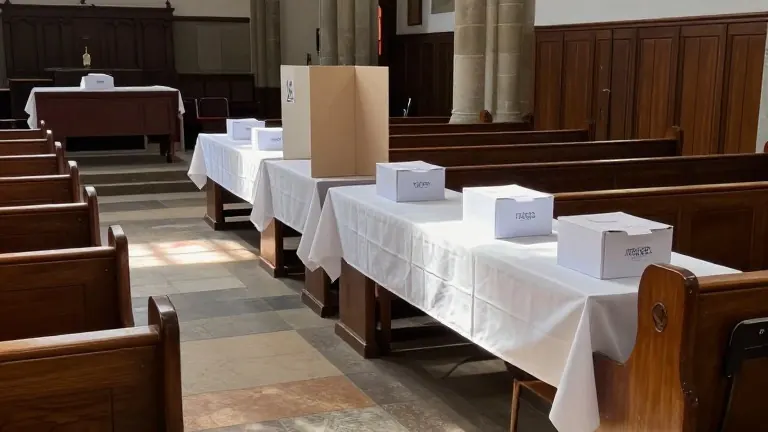
Coral Gables residents cast ballots at 14 designated locations on Tuesday, Nov. 3, during the 2026 midterm elections. St. Augustine Catholic Church served as one of these sites, operating from 7 a.m. to 7 p.m.
County election records indicate that the church has functioned as a polling place for more than a decade. The documentation lists the location for subsequent municipal elections dating back to 2011. This long-term stability provided a consistent venue for voters in the municipality.
Nicholas Campbell, a 30-year-old resident, cited local politics as his primary motivation for voting at this site. He stated that local decisions hold more weight for him than federal contests. “This is what sets your budget, what public works, and how they get funded,” Campbell said.
Other voters focused on specific policy concerns. Janice Muller, an alumna of the University of Miami, identified healthcare as a major issue. “There is absolutely no reason that we shouldn’t have better healthcare, and I am dedicated to electing people who are at least willing to try to make it better,” Muller said. Anne Marie Cummings, a UM freshman and first-time voter, expressed concern over rising costs for herself and the wider Miami community.
Cummings emphasized the impact of youth participation on the election outcome. “The more people that think they can’t [vote], the less people there are to really make a change,” she said. While individual ballots varied, voters at St. Augustine shared a consensus that civic engagement is essential to the community.
Matthew D. Nelsen, a political science professor at UM, noted that older Americans typically vote at higher rates. He explained that this group has had more opportunities to establish voting as a routine. “The more times that you vote, there is a likelihood that you vote in a subsequent election,” Nelsen said. He added that turnout is just one indicator of democratic health.
Nelsen pointed out that college voters often face additional hurdles, such as registration requirements and voting out of state. “Some of the biggest barriers to political participation among college-age students is just bureaucracy,” he said.